
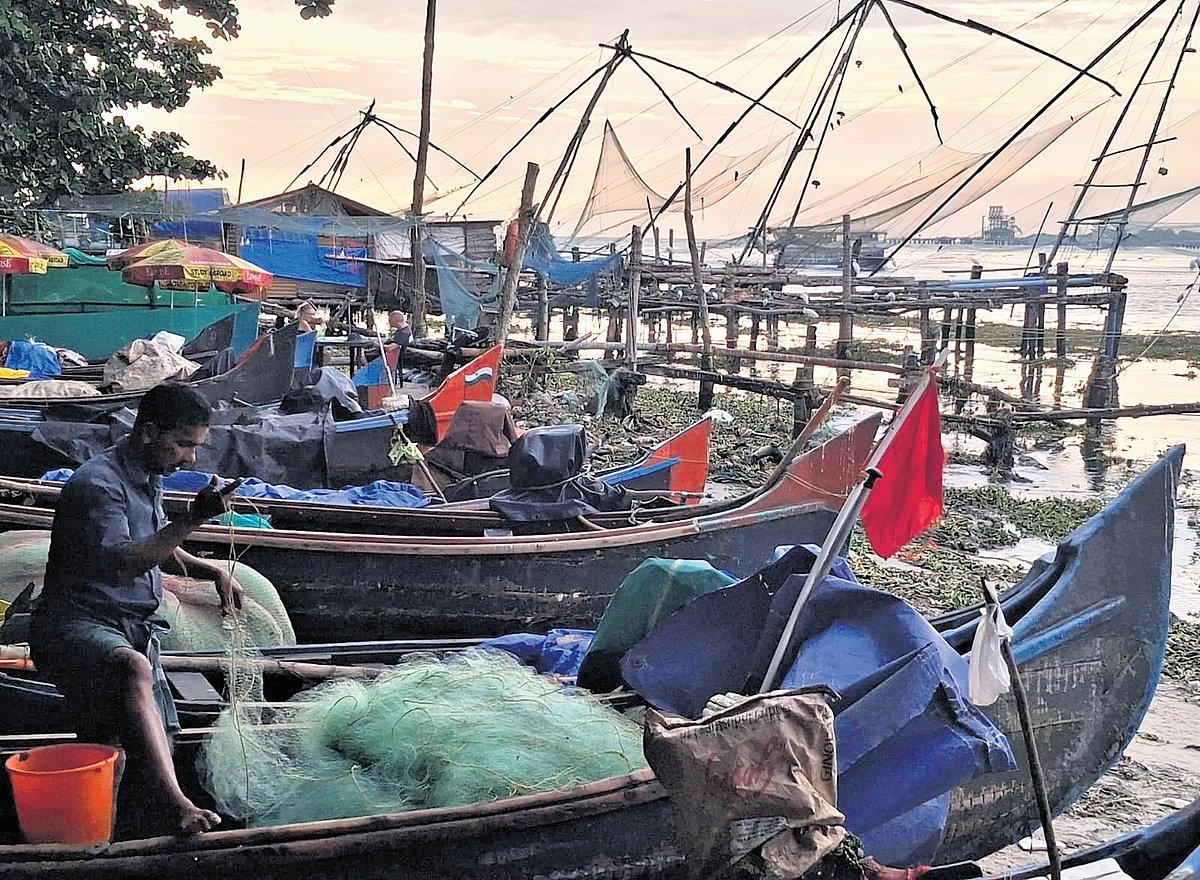
KOCHI:The traditional Chinese fishing nets, which are historic and cantilevered, mark the shoreline of Fort Kochi, but they are now in a state of neglect, with their essential restoration delayed for years even though a grant of Rs 2.40 crore was allocated. The need for urgent repairs was highlighted when a deteriorated platform of one of the nets collapsed, causing 11 foreign tourists to fall into the water last Friday.
Although the tourism department had assigned the Kerala Industrial and Technology Consultancy Organisation (Kitco) the responsibility of renovating 11 nets, the fishermen-owners highlight the organization's demand for a GST (Goods & Services Tax) account to receive the grant, which they claim is the cause of the delay in repairs.
Indeed, the incident with the foreign tourists occurred following the failure of a temporary plywood board, which replaced the usual hardwood, leading to the platform's collapse.
Kitco, however, states that GST is "mandatory" for the benefit of government funds, while pledging to issue a contract for urgent repairs within "four weeks".
"The repair of the Chinese nets was delayed because of bureaucratic rules requiring the owners to obtain a GST account. Why do poor fishermen need a GST account? They are not engaged in any major business or export. In fact, the lack of repairs has been impacting their lives for years," said K J Sohan, former mayor of Kochi and a lover of heritage. Adding to their losses, the precious teak and ironwood logs acquired years ago have begun to rot.
Due to persistent demands, the owners eventually established a group called 'Fish Net Association' and obtained a GST account. However, the owners express their disappointment that they have not yet received the money for repairs.
Owners of Chinese fishing nets request immediate release of funds
In reality, several owners, who performed minimal repair work under the promise of fund extension from Kitco, are now facing financial difficulties and are urgently requesting the release of the promised amount.
"I borrowed almost Rs 5 lakh for the fundamental restoration of my Chinese net. It has been three years since I submitted the expense invoices. We also obtained a GST account and provided the updated bills. However, they have not processed it yet. Now we are having difficulty repaying our loans and are dealing with significant debt," said Vincent, the owner.
Upon being contacted, a senior Kitco representative stated, "The head of the technical examination team in the tourism department has approved the updated invoices. As they have a GST account, the funds will be released shortly. The tax for the government fund needs to be subtracted. Essentially, we will commence the repairs within four weeks."
A court order has been issued to perform the repair work involving the property owners. A high-level five-member committee was established by the tourism department, with the local MLA serving as its head. There was a delay in securing the funding, but now all obstacles have been overcome," stated a Kitco representative, acknowledging that the administrative approval for the repairs was granted as early as 2015.
Meanwhile, Kitco has started the process of renovating Chinese online platforms with sandalwood. "The bidding process for this will be completed in two weeks, and the work will take an additional four weeks," the official stated.
As per the GST expert K S Hariharan, under current rules, a GST account is not essential for the owners to access the restoration fund or loan, as they are not currently involved in high-paying or export-oriented activities. "KITCO's requirement for a GST account could be due to anticipating significant tourism income from the restored nets."
GST registration is required only when a business's turnover goes beyond `20 lakh. Additionally, after registration, the owners will have to pay tax, either 5% or 18%, depending on their income. However, the owners can open a GST account and later terminate it," he mentioned.