
Thanks to a mouse viewing snippets from 'The Matrix,' Scientists have developed the most extensive functional map of a brain so far—a chart illustrating how 84,000 neurons connect as they transmit signals.
With just a tiny portion of the mouse’s brain, roughly the size of a poppy seed, scientists were able to pinpoint these specific nerve cells and follow their communication pathways as they extended through an unexpected network consisting of approximately 500 million connection points known as synapses.
The extensive data set, released on Wednesday in the journalNature, represents progress towards solving the puzzle of how our brains work.
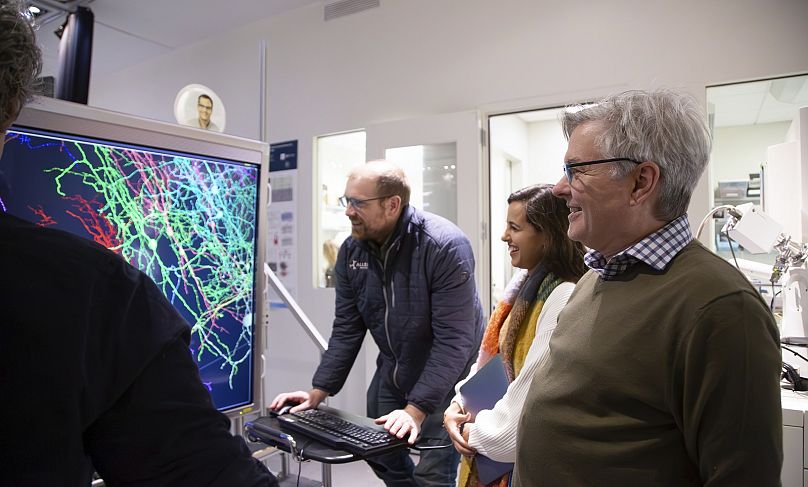
The information presented in a 3D reconstruction, with various colors used to differentiate distinct neural pathways, is available globally for further study by researchers as well as for those who are merely interested to explore.
"Forrest Collman from the Allen Institute for Brain Science in the U.S., one of the key researchers involved in this project, remarked that 'it certainly evokes a feeling of wonder, much like viewing images of distant galaxies,' " he stated.
You start to understand your own complexity. By examining just a small section of a mouse's brain, we can observe the remarkable intricacy present in these individual nerve cells along with their billions of interconnections.
Our thoughts, emotions, perceptions, speech, and movements result from the activity of neurons, which are nerve cells in our brain—how they get triggered and communicate with one another.
Scientists have been aware for a long time that these signals travel through neurons via structures known as axons and dendrites, leaping to the subsequent neuron through synapses.
However, lesser-known details exist regarding the neuron networks responsible for specific functions and how disturbances in their connections might contribute to various issues. Alzheimer's , such as autism or other conditions.
With the new project, a global team of more than 150 researchers mapped neural connections that Collman compares to tangled pieces of spaghetti winding through part of the mouse brain responsible for vision.
How scientists mapped the brain
The first step: show a mouse video snippets of sci-fi movies, sports, animation, and nature.
A research group at Baylor College of Medicine in the US achieved this by employing a genetically modified mouse whose neurons emit light when activated.
The scientists employed a laser-driven microscope to capture how the neurons in the creature’s visual cortex activated as they interpreted the rapidly displayed images.
Subsequently, researchers from the Allen Institute examined that tiny section of brain tissue. Using a specialized device, they sliced it into over 25,000 sections and captured almost 100 million high-resolution photographs with electron microscopes. Afterward, they meticulously reconstructed this information into a three-dimensional model.
Lastly, researchers at Princeton University in the U.S. utilized artificial intelligence (AI) to map out all those connections and “assign a distinct color to each wire so they can be identified separately,” as explained by Collman.
They reckoned that if the tiny wires were stretched out, they would extend for over 5 kilometers.
Implications for human health
Could this kind of mapping assist researchers in ultimately discovering cures for neurological disorders?
The researchers refer to this as a crucial initial phase, similar to how the Human Genome Project, which offered the first genetic map, ultimately paved the way for therapies based on genes.
One of the upcoming objectives is to map an entire mouse brain.
"The innovations from this initiative will provide our initial opportunity to genuinely pinpoint certain unusual patterns of connectivity that lead to disorders," stated Sebastian Seung, a Princeton-based neuroscientist and computer scientist who is one of the key figures in the project.
"The effort represents a significant step forward and provides an indispensable community asset for forthcoming revelations," noted Harvard neuroscientists Mariela Petkova and Gregor Schuhknecht, who were not part of the initiative.
The extensive and collectively accessible data "will aid in deciphering the intricate neurological networks that underlie thought and behavior," they mentioned additionally.