
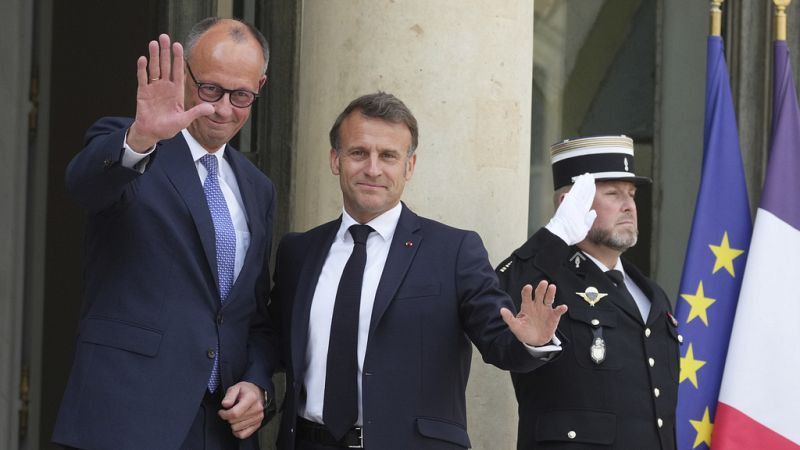
Following custom, Germany’s recently chosen Chancellor Friedrich Merz embarked on his inaugural foreign trip to France on Wednesday, aiming to usher in a fresh era in Franco-German relations.
The trip's symbolic importance was evident: it reignited what is frequently referred to as the EU's “ Franco-German engine.”
The most significant announcement from the joint press conference between Merz and French President Emmanuel Macron was the creation of a Franco-German Defence and Security Council, stating that both nations intended to "respond together to the challenges that Europe faces" and "act hand in hand."
In light of Moscow’s continuing conflict in Ukraine, Merz affirmed his intention to travel to Kyiv in the upcoming weeks, highlighting the aim of “achieving a durable truce and a peace accord with Russia.”
Although hesitant about deploying troops, Merz stated that Germany and France would provide "security assurances" to Ukraine after a durable truce and peace agreement have been established.
Merz emphasized that this objective can only be achieved with a stronger dedication from the United States.
In response to inquiries regarding the delivery of long-range Taurus missiles to Ukraine, the French president stated: "Let's share minimal information. For the Ukrainians, ambiguity works best."
Regarding the contentious topic of nuclear deterrence, Germany's newly appointed chancellor stated his intention to "talk with France and Great Britain" about this matter within Europe.
He mentioned that this discussion is "clearly viewed as an addition to what we already have with our American partners through NATO."
Paris remains optimistic about the new chancellor
For Merz, who at 69 years old leads the conservative Christian Democratic Union (CDU) as their party head, this trip offered an opportunity to recalibrate the atmosphere following a challenging beginning to his tenure as chancellor.
Merz did not secure enough votes to win during the initial round of elections in Germany's Bundestag, leading to an embarrassing setback that has attracted attention both domestically and internationally.
However, Paris is adopting an optimistic stance. Merz might turn out to be a more compatible partner for Macron compared to his previous one, Olaf Scholz.
Merz's choice to relax Germany’s stringent fiscal regulations, especially to enhance defense expenditures, has received approval in Paris.
Merz's bolder position opposing US President Donald Trump also syncs with Macron’s long-standing advocacy for increased European independence.
Nevertheless, the two leaders continue to differ on various fundamental matters, such as the Mercosur trade deal.
Similar to Scholz, Merz supports open trade policies, whereas France adopts a more protective stance.
At the press conference, the French leader stated: "We support trade deals provided they safeguard European producers."
However, Merz said that the European Union must “quickly” ratify the free trade agreement between the EU and the Mercosur countries.