
HG Wells instilled belief in me regarding time travel. The 1895 book "The Time Machine," which I encountered during my childhood, persuaded me that using such a device, someone can journey to either the past or the future.
Therefore, I had a dream about going back in time to witness what the Philippines was like during the colonial era. The vision included exploring charming homes adorned with capiz windows and encountering folks wearing clothes typical of that period.
However, subsequently, I came across Albert Einstein and his "theory of relativity." This theory asserts that time and space are interconnected, and true time travel occurs solely within movies and sci-fi narratives. Initially, this realization left me disheartened. Nonetheless, I quickly understood that I could journey through history simply by exploring locations around my homeland known for maintaining their cultural legacy. Sites such as Vigan, Iloilo, Batanes, among others captured my interest; yet, the place where I frequently seek solace from temporal confines—Taal, Batangas—is particularly dear to my heart.
The volcano, the lake, and the city
Taal Town originated at the lakeside of Taal Lake, home to the renowned Taal Volcano. Established in 1572 by the Augustinians, it gained status as the provincial capital of Batangas in 1732. However, this situation altered drastically in 1754 when the catastrophic eruption of Taal Volcano obliterated much of the town’s structures including its main church and numerous homes near the water body. This natural disaster compelled inhabitants to vacate their initial settlement area and move towards more secure locations. A significant number opted for higher grounds approximately ten kilometers south-westward, settling down in an area known as Caysasay.
In 1755, the inhabitants commenced construction of their homes at what would become the town’s current site; then, by 1758, they initiated the build of a new Taal Church to stand in place of the previous structure ruined by the volcanic eruption. Despite losing its designation as the provincial capital to Batangas City over time, Taal persisted as the heart of commerce and trade within the region for many generations.
Traveling to Taal
Visiting this historic town doesn’t require a time machine. You can get here more easily than you might think—just under three hours by car. To find the quickest path, head south using the South Luzon Expressway (SLEX) and follow the Southern Tagalog Arterial Road (STAR). Exit at Lipa-Tambo and proceed on the Maharlika Highway. Make a right towards Cuenco, pass through Alitagtag, and keep going until you hit Muzon; from there, steer right onto the road leading to Santa Teresita and ultimately reaching Taal.
As an alternative, you could take the route through Tagaytay. Upon arriving at the border of Tagaytay and Nasugbu, make a left turn onto Diokno Highway, proceed towards Lemery, and continue onward to Taal.
You can also travel to Taal via a DLTB or JAM bus heading towards Lemery from Buendia. Inform the driver to let you out at Jollibee Taal Diversion. Then, hop onto a jeepney going to Lemery which will pass through Taal Poblacion.
Taal Basilica and Caysasay Shrine
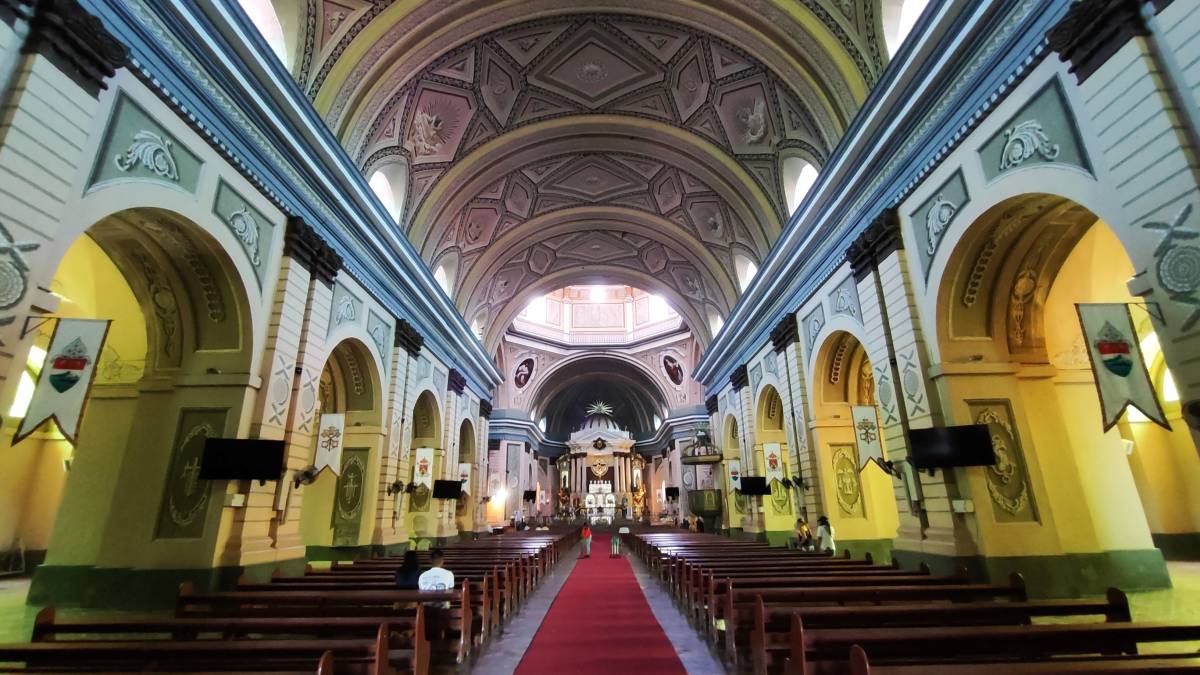
The town’s premier attraction is the Taal Basilica, formally named the Parish of Saint Martin de Tours, constructed in the Italian Baroque style sometime around 1758. Spanning an impressive length of 88.6 meters and breadth of 48 meters, this structure holds the title of being both the biggest Catholic church in the Philippines and Asia. Directly opposite lies the disused graveyard called Libingan ng mga Kastila, which was erected approximately in 1800, serving formerly as the final resting place for local clergy and esteemed townsfolk.
You can take a short 20-minute trip to San Nicolas for a glimpse of the old Taal church’s remains. This historical site is situated next to the lake, close to the San Nicolas public market.
Starting from Taal Poblacion, you can trace the path of the San Lorenzo Ruiz Stairway up to the Archdiocesan Shrine of Our Lady of Caysasay. Constructed in 1611 close to the riverside where the statue of the Virgin Mary was discovered, this church has faced numerous damages due to volcanic activities and seismic events over time. Most recently, these issues arose during the January 2020 eruption of Taal Volcano, which caused cracks in the facade of the shrine. Following an extensive renovation process spanning four years, it finally welcomed visitors again on June 20, 2024. Just a brief stroll away lies the Well of Santa Lucia, a legendary healing spring believed to possess curative properties.
Traditional homes and the bustling community bazaar
Over a hundred heritage homes can be found in Taal. Although some have transformed into accommodations, eateries, and galleries, numerous others still serve as personal dwellings. The National Historical Commission of the Philippines (NHCP) manages two sites within this area: Museo ni Leon located at Galicano Apaciable, which highlights the existence and abode of Leon Apacible; and another museum dedicated to Marcela Mariño and Felipe Agoncillo, detailing how the inaugural Philippine flag was meticulously crafted by Marcela Agoncillo. Additionally, visitors should not miss out on Galleria Taal, widely recognized as the Camera Museum, featuring an extensive array of old-fashioned cameras from around the latter part of the nineteenth century.
A visit to Taal isn’t considered complete unless you explore its vibrant local market. This marketplace offers an array of items that put Taal on the map—balisongs (butterfly knives), peanut brittle, kapeng barako (a type of Liberica coffee), suman Taal, and empanadas. A specific area within this market showcases tapang Taal, which consists of thin slices of pork steak steeped in a marinade of soy sauce, calamansi juice, and garlic. On the opposite side, numerous vendors peddle Burdang Taal, known as the town’s celebrated embroidery work. For generations, Taal’s women have produced exquisite handmade embroideries from materials like piña and jusi fibers, transforming them into sophisticated Barong Tagalog garments and bridal gowns.
However, for an unparalleled journey through time, make your way to Villa Tortuga. At this location, you can adorn yourself in traditional Filipino attire from the 1890s and capture photographs within its majestic historical settings. While it doesn’t function as a genuine time machine, it offers the nearest sensation of traveling back to the 19th century in Taal.